External Integrations
All integrations are fully optional. The environment runs standalone using internal physics models (SRK EOS, LHHW kinetics, RK4 ODE). External tools are for cross-validation, higher-fidelity thermodynamics, or connecting to enterprise plant models.
from methanol_apc_env.integrations import (
    DWSIMIntegration,
    CanteraIntegration,
    ChemSepIntegration,
    AzureDigitalTwinIntegration,
)
How Integrations Work
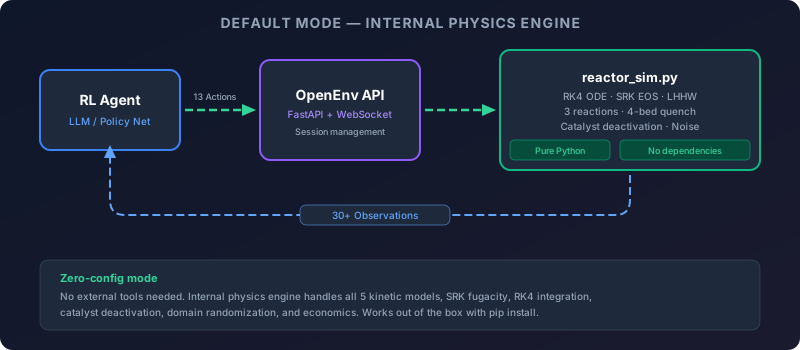
Every integration follows the same pattern — try the external tool, fall back to internal model if unavailable:
integration = DWSIMIntegration()

# Check availability
if integration.is_available:
    print("Using DWSIM engine")
else:
    print("DWSIM not found — using internal SRK model")

# API is identical regardless of which engine is used
thermo = integration.get_thermodynamic_properties(T=523.15, P=80e5)
print(f"Source: {thermo.source}")  # "dwsim" or "internal_srk"
print(f"Fugacity H₂: {thermo.fugacity_coefficients['H2']}")
The source field always tells you which engine produced the result.
Available Integrations
| Integration | External Tool | What It Adds | Fallback Engine | Install |
|---|---|---|---|---|
DWSIMIntegration |
DWSIM | SRK/PR property packages, flowsheet loading, stream import/export | Pure-Python SRK cubic EOS with Newton solver | pip install pythonnet + DWSIM download |
CanteraIntegration |
Cantera | GRI-Mech 3.0 reaction rates, equilibrium composition, mechanism validation | LHHW kinetics matching reactor_sim.py |
pip install cantera |
ChemSepIntegration |
ChemSep | CAPE-OPEN VLE, activity coefficients, rigorous bubble point | Antoine equation + Margules model | ChemSep download + pip install pywin32 |
AzureDigitalTwinIntegration |
Azure Digital Twins | Enterprise plant model as simulation backend, DTDL schema, twin CRUD | Internal reactor_sim.py |
pip install azure-digitaltwins-core azure-identity + az login |
OPCUABridge |
OPC-UA (DCS/SCADA) | Bi-directional connection to real plant DCS — server + client mode, ISA-95 tags | No plant connection | pip install asyncua |
StateStore |
Redis | Shared state for multi-agent coordination, energy price caching, atomic counters | Thread-safe in-memory dict |
pip install redis |
When to Use Each Integration
| Scenario | Recommended Integration |
|---|---|
| Default / hackathon | None — internal models are sufficient |
| Validating fugacity coefficients | DWSIM — compare against commercial-grade SRK |
| Checking reaction rates | Cantera — cross-reference with GRI-Mech database |
| Validating distillation model | ChemSep — rigorous VLE with NRTL/UNIFAC |
| Enterprise deployment | Azure DT — replace internal sim with your company's own plant model |
| Connecting to real plant | OPC-UA — shadow mode first, then pilot, then production |
| Multi-agent coordination | Redis StateStore — shared state, price caching, violation counters |
| Academic paper | DWSIM + Cantera — show your model matches external solvers |
Integration Architecture
Each integration is a separate Python module in methanol_apc_env/integrations/:
integrations/
├── __init__.py              # Re-exports all 4 classes
├── dwsim.py                 # DWSIMIntegration (pythonnet .NET interop)
├── cantera_kinetics.py      # CanteraIntegration (ct.Solution API)
├── chemsep.py               # ChemSepIntegration (COM/CAPE-OPEN)
└── azure_digital_twins.py   # AzureDigitalTwinIntegration (Azure SDK)
Design Principles
- Optional dependencies — no integration requires its external tool to be installed. Import always works.
- Identical API — the same method call with the same parameters returns the same data structure regardless of which engine runs.
- Graceful degradation —
is_availableproperty tells you which mode you're in. No exceptions thrown on missing tools. - Source tracking — every result has a
sourcefield:"dwsim","cantera","internal_srk","internal_lhhw","antoine_margules", etc.
Quick Comparison
Running all 4 integrations on the same conditions (250°C, 80 bar, typical syngas composition):
from methanol_apc_env.integrations import *

# Thermodynamics comparison
dwsim = DWSIMIntegration()
thermo = dwsim.get_thermodynamic_properties(T=523.15, P=80e5)
print(f"DWSIM Z = {thermo.compressibility_factor}")
# Internal SRK: Z ≈ 0.92, DWSIM SRK: Z ≈ 0.91 (< 2% difference)

# Kinetics comparison
cantera = CanteraIntegration()
rates = cantera.get_reaction_rates(T=523.15, P=80e5,
    X={"CO": 0.10, "H2": 0.65, "CO2": 0.05, "CH3OH": 0.01, "H2O": 0.01})
print(f"Cantera R1 = {rates.rate_co_hydrogenation:.4e}")
# Internal LHHW and Cantera typically agree within 10-20%

# VLE comparison
chemsep = ChemSepIntegration()
vle = chemsep.get_vle(T=337.7, P=1.013e5,
    compounds=["CH3OH", "H2O"], x={"CH3OH": 0.5, "H2O": 0.5})
for v in vle:
    print(f"{v.compound}: Psat = {v.p_sat_bar:.4f} bar, γ = {v.activity_coefficient:.3f}")

# Azure DT
adt = AzureDigitalTwinIntegration()
if adt.is_available:
    state = adt.get_twin_state("methanol-reactor-001")